RA V16 N2, Message from the Editor-in-Chief (May – August, 2026)
Keywords:
concrete, compressive strength, nopal mucilage, expanded polystyrene waste, prefabricated stilt house, in situ, reinforced concrete, inspection, ICOMOS, durability of coating mortarsAbstract
LATIN AMERICAN JOURNAL OF QUALITY CONTROL, PATHOLOGY AND RECOVERY OF CONSTRUCTION
http://www.revistaalconpat.org
It is a source of satisfaction and joy for the ALCONPAT Journal team to see the publication of the second issue of our sixteenth year.
The objective of the Revista ALCONPAT (RA) is the publication of citable production (basic or applied research, and reviews), documentary research and case studies, related to the topics of our association, that is, quality control, pathology and recovery of constructions.
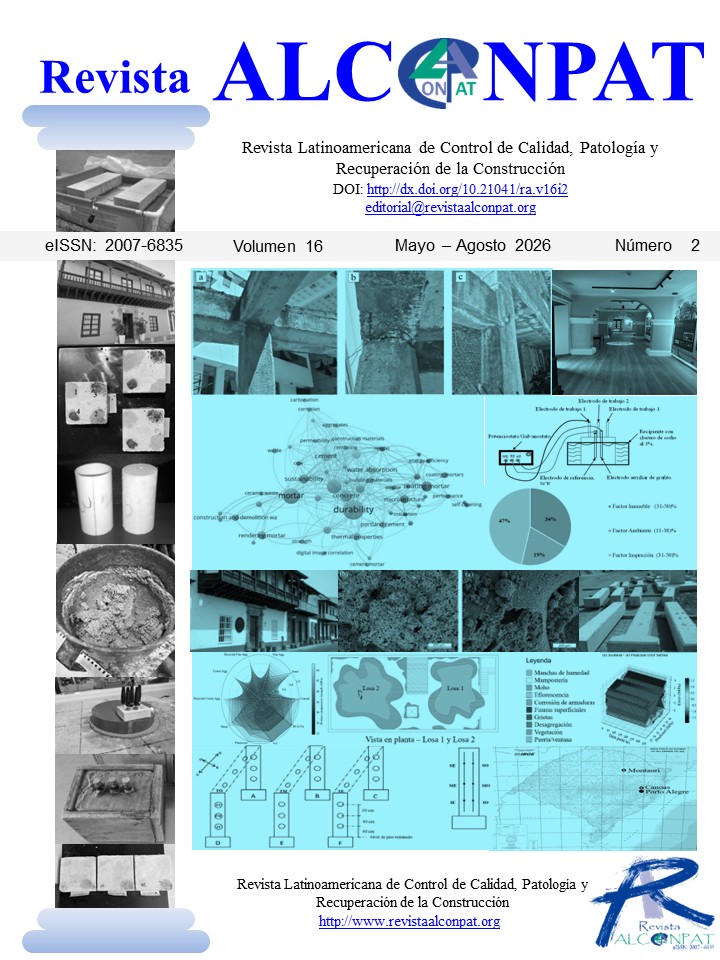
This V16 N2 edition begins with a work from India, where Swatantra Gopal and Amrendra Kumar show us how evaluate and predict the compressive strength of recycled aggregate concrete (RAC) using experimental testing and machine learning techniques. Twenty-five concrete mixes with varying recycled aggregate content, water cement ratio, plasticizer dosage, and parent concrete strength were investigated. The 28-day compressive strength ranged from 31.8 to 45.2 MPa, decreasing with higher recycled aggregate content and water absorption. Support Vector Regression achieved the highest prediction accuracy (R2 = 0.998), outperforming other models. The study is limited by dataset size and controlled data expansion. The originality lies in integrating experimental investigation with multi-model machine learning analysis. The results demonstrate that AI can effectively support sustainable mix design of recycled aggregate concrete.
In the second work, by Charles Michel Lasta and colleagues, from Brazil, a study is presented where the performance of lime mortars modified with titanium dioxide (TiO2) and metakaolin (MK), focusing on compressive strength and self-cleaning capacity. Six different formulations were molded and tested for consistency, mechanical strength and color variation after exposure to natural weathering. The results indicated that TiO2 improves both self-cleaning and compressive strength, with a statistically significant effect on color variation (ΔE). The presence of MK had no immediate impact on strength. The originality of the study lies in the joint evaluation of TiO2 and MK in lime mortars exposed to different microclimates. It is concluded that TiO2 contributes to the functional performance of mortars.
In the third article from Mexico, Jorge Uruchurtu Chavarin and colleagues present a paper that focused on the study of reinforced concrete (RC) with the addition of nopal mucilage (NM) and (polyethylene terephthalate) PET aggregates. Samples were prepared with different PET geometries: particles (P), a mixture of long fibers and particles (LF-P), and short fibers (SF) combined with NM. Samples were evaluated using half-cell potential (HCP), electrochemical noise (EN), and linear polarization resistance (LPR). A decrease in compressive strength (f'c) values was observed with increasing PET percentage. Samples with PET and NM achieved lower values of corrosion rate (Icorr). PET design and storing the NM can be a challenge to analyze. Both materials contributed to increased the durability of RC.
The fourth paper in this issue is from Spain, where Alicia Zaragoza Benzal and colleagues developed new gypsum composites by reusing large volumes of expanded polystyrene (EPS) waste through chemical recycling, thereby replacing natural raw materials. Physicochemical, mechanical and environmental characterisation enabled analysis and comparison based on the solvent used. The composites exhibit lower density and thermal conductivity, with good mechanical performance. The environmental impact of the composites is primarily linked to the type of solvent used, and further research is needed to explore more sustainable alternatives. This dissolution process induces microstructural changes, reducing crystal size and causing crystal agglomeration depending on the type of solvent used. The new composites promote the use of secondary materials whilst improving energy efficiency in buildings.
The fifth article, by Jorge Briceño Mena and colleagues, comes from Mexico. The objective of this work was to analyze the impact of design and durability monitoring strategies on the internal electrochemical and microenvironmental results, at the level of the reinforcement of some columns, obtained during seven years in the fifth generation of the substructure of a prefabricated stilt house, according to criteria that gave rise, at the time, to the NMX-530-ONNCCE-2018 and NMX-569-ONNCCE-2018 standards on durability. The results showed that, although the elements are completely passive, the design, construction, and monitoring strategies allowed to clearly see the influence of each microenvironment on electrochemical trends. This will allow the design of ad hoc and economical strategies for preventive maintenance, as well as facilitate the recalibration of service life projections according to each microenvironment.
The sixth article, by José Enrique Ramón and colleagues from Spain, presents the experimental evaluation of a novel methodology for the in situ assessment of corrosion in reinforced concrete structures. The technique is based on dynamic control of the applied current to maintain appropriate polarization conditions. Laboratory tests were conducted on specimens with different concrete types and exposure conditions. The results show improved polarization control compared to previous generations of confined current corrosion meters, with corrosion rate values comparable to reference techniques such as Linear Polarization Resistance and embedded multiparametric systems. The originality lies in ensuring appropriate polarization regardless of corrosion state through a non-invasive approach, demonstrating strong potential as an effective tool for corrosion diagnosis.
In the seventh work, from Bolivia, Joaquín Humberto Aquino Rocha and colleagues present a case study that aims aims to evaluate the structural suitability of an existing reinforced concrete building. The methodology is based on the integration of visual inspection, non-destructive testing (rebound hammer, ultrasonic pulse velocity, and infrared thermography), and load testing on slabs. The results reveal an unfavorable condition, with material heterogeneity, internal degradation, and non-uniform structural behavior. Limitations include the absence of destructive testing and detailed structural information. The originality lies in integrating evaluation techniques at different levels of the structural system. It is concluded that the structure is not fully suitable for use in its current condition.
The eighth article by Rosa Eugenia Malave de Corrales, comes from Venezuela, and presents a case study. The objective of this work is to assess the percentage weighting of factors and indicators to determine the conservation status and calculate the physical depreciation of a building. A qualitative scientific approach was applied through the Delphi technique, involving 34 experts. Inspection-related indicators accounted for 47%, compared to building factors at 34% and environmental factors at 19%. It was identified that the structural system, when presenting severe failures, poses the highest risk of collapse; the most frequent pathologies are cracks and water infiltration. Although the study relies on expert judgment rather than direct measurements, it proposes percentage values applicable to future quantitative methods for estimating conservation status and depreciation. In conclusion, technical inspection is decisive and must be prioritized over other factors.
The ninth paper in this issue is from Venezuela, where Oswell Salvador Ippolito Ojeda presents a documentary investigation of how contemporary interventions can affect the authenticity of Venezuelan colonial built heritage. A methodology combining a theoretical-practical contrast analysis is employed, using the intervention at Casa Herrera as a case study, and complemented by an institutional communication from ICOMOS Venezuela. The results demonstrate a methodological disconnect and limited institutional oversight, where the priority of current function compromises historical truth and technical compatibility, altering the morphological and physical integrity of the building. The article's originality lies in its critical and direct evaluation of the actual application of international principles. It concludes that it is urgent to establish defined thresholds for additions that guarantee functionality without distorting the historical materiality.
The tenth article that closes the edition is by Géssica Bilcati and colleague from Brazil, who present another documentary research that aims to analyze scientific production on the durability of rendering mortars. To this end, the Methodi Ordinatio method was applied in a bibliometric review of articles published between 2018 and 2023. A total of 323 studies were identified across four databases, of which 16 met the selection criteria. The studies indicate that research on rendering mortars is mainly focused on mechanical properties, particularly compressive and flexural strength. About durability, water absorption and carbonation resistance tests are the most used indicators of degradation, although the lack of standardized regulations makes it difficult to compare results across studies. A growing trend toward the use of alternative materials with promising results in improving performance and reducing environmental impacts was also observed. In addition, the application of Life Cycle Assessment tools reinforces the need to integrate durability and sustainability, promoting more efficient and long-lasting construction solutions.
This is an issue of Alconpat Magazine where, after additional rigorous refereeing, three of the best papers from the CONPAT 2025 congress that was held in Madrid, Spain from September 24 to 26, 2025, are published. These are the article that won the Eduardo Torroja award, by José Ramón and colleagues from the Eduardo Torroja Institute of Construction Sciences (IETCC) in Madrid, Spain, the article from Mexico that won the Alconpat award in Quality Control of Constructions by Jorge Alberto Briceño Mena and colleagues, and finally the work from Spain that won the Honorable Mention of Technical-Scientific Excellence award in Recovery of Constructions by Alicia Zaragoza Benzal and colleagues. As happens every two years, during 2026 and 2027 the President of the CONPAT Scientific Committee joins the editorial team as Co-Editor-in-Chief, Dr. José Luis García Calvo of the IETCC. We wish you a successful management. We are sure that the articles in this issue will constitute an important reference for those readers involved with issues of evaluations and characterizations of materials, elements and structures. We thank the authors participating in this issue for their willingness and effort to present quality articles and comply with the established deadlines.
Little by little, the quantity, quality and geographical scope of the published works has increased. On this occasion there were ten works, of which six were basic research from India, Brazil, Mexico and Spain; two case studies from Bolivia and Venezuela; and two documentary research projects from Venezuela and Brazil.
Our performance as Alconpat Magazine was rewarded with our inclusion in Dialnet and Scopus two years ago. We hope to apply for Journal Citation Reports in 2026, which is the index with the highest international coverage and quality. We count on you and your best work for it.
These are reasons to celebrate for our community that has made a scientific investment in our journal looking forward to moments like this. Congratulations to all.
By the Editorial Board
Pedro Castro Borges
Editor-in-Chief
Downloads
References
Revista Alconpat
Published
How to Cite
Issue
Section
License
Copyright (c) 2026 Castro-Borges, P.

This work is licensed under a Creative Commons Attribution 4.0 International License.
_______________________________
License in effect from September 2020
You are free to:
- Share — copy and redistribute the material in any medium or format for any purpose, even commercially.
- Adapt — remix, transform, and build upon the material for any purpose, even commercially.
- The licensor cannot revoke these freedoms as long as you follow the license terms.
Under the following terms:
- Attribution — You must give appropriate credit , provide a link to the license, and indicate if changes were made . You may do so in any reasonable manner, but not in any way that suggests the licensor endorses you or your use.
- No additional restrictions — You may not apply legal terms or technological measures that legally restrict others from doing anything the license permits.
Notices:
You do not have to comply with the license for elements of the material in the public domain or where your use is permitted by an applicable exception or limitation .
No warranties are given. The license may not give you all of the permissions necessary for your intended use. For example, other rights such as publicity, privacy, or moral rights may limit how you use the material.
















.png)