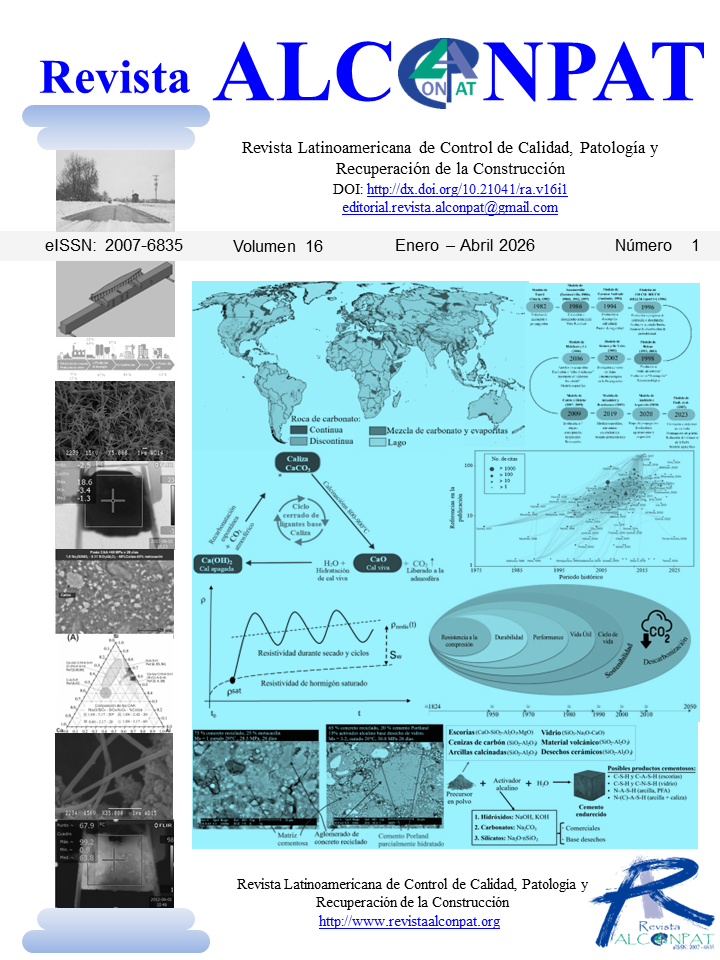
The enduring legacy of limestone: from an ancestral pillar of construction to a modern precursor in synergy with recycled concrete.
DOI:
https://doi.org/10.21041/ra.v16i1.838Keywords:
limestone, Portland cement, recycled concrete, alkali-activated cements, sustainable cementsAbstract
Facing the urgent need to reduce the environmental impact of Portland cement, this review explores the potential of limestone and pulverized recycled concrete (PRC) as pillars for sustainable binders. The historical and current role of limestone is analyzed, from its ancestral use to its application in modern cements, LC3, and, crucially, as a precursor in alkali-activated cements (AACs). PRC as a precursor in AACs is also examined, highlighting its contribution to the circular economy. The environmental and performance advantages of AACs based on these materials are discussed, as well as key challenges, including long-term durability, raw material variability, and the need for standardization. It is concluded that both resources are strategic, requiring focused research for their effective implementation.
Downloads
References
Aboulayt, A., Riahi, M., Touhami, M. O., Hannache, H., Gomina, M., Moussa, R. (2017). Properties of metakaolin-based geopolymer incorporating calcium carbonate. Adv. Powder Technol., 28, 2393–2401. https://doi.org/10.1016/j.apt.2017.06.022. DOI: https://doi.org/10.1016/j.apt.2017.06.022
Ahmari, S., Ren, X., Toufigh, V., Zhang, L. (2012). Production of geopolymeric binder from blended waste concrete powder and fly ash. Construction and Building Materials, 35, 718-729. https://doi.org/10.1016/j.conbuildmat.2012.04.044. DOI: https://doi.org/10.1016/j.conbuildmat.2012.04.044
Akhtar, A., Sarmah, A. K. (2018). Construction and demolition waste generation and properties of recycled aggregate concrete: A global perspective. Journal of Cleaner Production, 186, 262-281. https://doi.org/10.1016/j.jclepro.2018.03.085. DOI: https://doi.org/10.1016/j.jclepro.2018.03.085
Borrachero, M. V., Payá, J., Brito, S., Segura, Y. P., Soriano, L., Tashima, M. M., Monzó, J. M. (2022). Reusing construction and demolition waste to prepare alkali-activated cement. Materials, 15(10), 3437 https://doi.org/10.3390/ma15103437. DOI: https://doi.org/10.3390/ma15103437
Cembureau, The European Cement Association (1991). Cement Standards of the World, Brussels, Belgium. Retrieved from http://www.cembureau.eu (Accessed: 20 January 2024).
Chan, C. L., Zhang, M. (2023). Effect of limestone on engineering properties of alkali-activated concrete: A review. Const BuildMater, 362, 129709. https://doi.org/10.1016/j.conbuildmat.2022.129709. DOI: https://doi.org/10.1016/j.conbuildmat.2022.129709
Chen, K., Wang, J., Yu, B., Wu, H., Zhang, J. (2021). Critical evaluation of construction and demolition waste and associated environmental impacts: A scientometric analysis. Journal of Cleaner Production, 287, 125071. https://doi.org/10.1016/j.jclepro.2020.125071. DOI: https://doi.org/10.1016/j.jclepro.2020.125071
Courland, R. (2011). Concrete Planet. Prometheus Books, New York. ISBN 978-1-61614-482-4.
ECOCEM Global (2024). ACT The next generation of low carbon cement technology, https://www.ecocemglobal.com/act/ (accessed 10 February 2024).
Escalante-Garcia, J. I., Perez-Cortes, P., (2018), Hydraulic cement based on alkaline earth carbonates like limestone and calcined clay and process to make pastes, mortar and concretes of high performance, Patent application MX/a/2018/ 016140
Escalante-Garcia J. I., Perez-Cortes P., Rodriguez-Morales J., Hernández Bielma J. M., Reyna-Perez, J. L. (2024), Significancia histórica de la Caliza, desde cementos ancestrales hasta los cementos de hoy y perspectivas de futuro, Memorias del XI Congreso Nacional de Alconpat México, Vol. 2024, Num. 1, Eds P. F. de J. Cano Barrita, E. M. Alonso Guzmán, T. Pérez López y P. Castro Borges. Oaxaca de Juárez, Oaxaca, México DOI: https://doi.org/10.21041/XICNAM2024
European Committee for Standardization (2000). Cement - part 1: composition, specifications and conformity criteria for common cements. EN 197-1, Brussels. Retrieved from http://www.rucem.ru/yabbfiles/Attachments/EN-197-1.pdf
Gao, X., Yu, Q. L., Brouwers, H. J. H. (2015). Properties of alkali activated slag–fly ash blends with limestone addition. Cem. Concr. Compos., 59, 119–128. https://doi.org/10.1016/j.cemconcomp.2015.01.007. DOI: https://doi.org/10.1016/j.cemconcomp.2015.01.007
Goldscheider, N., Chen, Z., Auler, A. S., Bakalowicz, M., Broda, S., Drew, D., Veni, G. (2020). Global distribution of carbonate rocks and karst water resources. Hydrogeology Journal, https://doi.org/10.1007/s10040-020-02139-5. DOI: https://doi.org/10.1007/s10040-020-02139-5
Juenger, M. C. G., Snellings, R., Bernal, S. A. (2019). Supplementary cementitious materials: New sources, characterization, and performance insights. Cem Concr Res, 122, 257-273. https://doi.org/10.1016/j.cemconres.2019.05.008. DOI: https://doi.org/10.1016/j.cemconres.2019.05.008
Komnitsas, K., Zaharaki, D., Vlachou, A., Bartzas, G., Galetakis, M. (2015). Effect of synthesis parameters on the quality of construction and demolition wastes (CDW) geopolymers. Advanced Powder Technology, 26(2), 368-376. https://doi.org/10.1016/j.apt.2014.11.012. DOI: https://doi.org/10.1016/j.apt.2014.11.012
Krivenko, P. (2017). Why Alkaline Activation – 60 Years of the Theory and Practice of Alkali-Activated Materials. J. Ceram. Sci. Technol., 08(3), 323-334. https://doi.org/10.4416/JCST2017-00042.
Ma, J., Wang, T., et al. (2022). A state-of-the-art review on the utilization of calcareous fillers in alkali-activated cement. Constr Build Mater, 357, 129348. https://doi.org/10.1016/j.conbuildmat.2022.129348. DOI: https://doi.org/10.1016/j.conbuildmat.2022.129348
Menchaca-Ballinas, L. E., Escalante-García, J. I. (2020). Limestone as aggregate and precursor in binders of waste glass activated by CaO and NaOH. Constr. Build. Mater., 262, 120013. https://doi.org/10.1016/j.conbuildmat.2020.120013. DOI: https://doi.org/10.1016/j.conbuildmat.2020.120013
Monteiro, J. M., Sabbie A, Horvath A. (2017). Towards Sustainable Concrete. Nature Materials, 16(7), 698–99. https://doi.org/10.1038/nmat4930. DOI: https://doi.org/10.1038/nmat4930
Ortega-Zavala, D., Santana-Carrillo, J. L., Burciaga-Díaz, O., Escalante-Garcia, J. I. (2019). An Initial Study on Alkali Activated Limestone Binders. Cem Concr Res, 120, 267–78. https://doi.org/10.1016/j.cemconres.2019.04.002. DOI: https://doi.org/10.1016/j.cemconres.2019.04.002
Özalp, F., Yılmaz, H. D., Kara, M., Kaya, Ö., Şahin, A. (2016). Effects of recycled aggregates from construction and demolition wastes on mechanical and permeability properties of paving stone, kerb and concrete pipes. Construction and Building Materials, 110, 17-23. https://doi.org/10.1016/j.conbuildmat.2016.01.030. DOI: https://doi.org/10.1016/j.conbuildmat.2016.01.030
Panesar, D. K., Zhang, R. (2020), Performance comparison of cement replacing materials in concrete: Limestone fillers and supplementary cementing materials – A review. Construction and Building Materials vol 251, 118866, https://doi.org/10.1016/j.conbuildmat.2020.118866. DOI: https://doi.org/10.1016/j.conbuildmat.2020.118866
Perales-Santillan, M. E., Díaz-Aguilera, J. H., Mendoza-Rangel, J. M. (2024). Evaluation of the rheological behavior for alkaline-activated cements of metakaolin and limestone for its potential application in 3D printing. Iran J Sci Technol Trans Civ Eng. https://doi.org/10.1007/s40996-024-01363-3. DOI: https://doi.org/10.1007/s40996-024-01363-3
Perez-Cortes, P., Escalante-Garcia, J. I. (2020a). Alkali activated metakaolin with high limestone contents – Statistical modeling of strength and environmental and cost analyses. Cem Concr Compos, 106, 103450. https://doi.org/10.1016/j.cemconcomp.2019.103450. DOI: https://doi.org/10.1016/j.cemconcomp.2019.103450
Perez-Cortes, P., Escalante-Garcia, J. I. (2020b). Design and optimization of alkaline binders of limestone-metakaolin: a comparison of strength, microstructure, and sustainability with Portland cement and geopolymers. J. Clean. Prod., 273, 123118. https://doi.org/10.1016/j.jclepro.2020.123118. DOI: https://doi.org/10.1016/j.jclepro.2020.123118
Perez-Cortes, P., Escalante-Garcia, J. I. (2020c). Gel composition and molecular structure of alkali-activated metakaolin-limestone cements. Cement Concr. Res., 137, 106211. https://doi.org/10.1016/j.cemconres.2020.106211. DOI: https://doi.org/10.1016/j.cemconres.2020.106211
Perez-Cortes, P., Cabrera-Luna, K., Escalante-Garcia, J. I. (2021). Alkali-activated limestone/metakaolin exposed to high temperatures: structural changes. Cem. Concr. Compos. 122, 104147. https://doi.org/10.1016/j.cemconcomp.2021.104147. DOI: https://doi.org/10.1016/j.cemconcomp.2021.104147
Perez-Cortes, P., Escalante-Garcia, J. I. (2023). Effect of the Limestone Content on the Durability of Alkali-Activated Limestone-Metakaolin Subjected to Acidic and Sulfate Environments, in Proc 75th RILEM Annual Week. RILEM Bookseries, Vol 40, Escalante-Garcia J.I. et al. (eds). Springer, ISBN 978-3-031-21734-0 ISBN 978-3-031-21735-7 (eBook), https://doi.org/10.1007/978-3-031-21735-7_64. DOI: https://doi.org/10.1007/978-3-031-21735-7_64
Purdon, A. (1940). The action of alkalis on blastfurnace slag. Journal of the Society of Chemical Industry - Transactions and Communications, 59, 191-202.
Qian, J., Song, M. (2015). Study on influence of limestone powder on the fresh and hardened properties of early age metakaolin-based geopolymer. In: K. Scrivener, A. Favier (Eds.), Calcined Clays for Sustainable Concrete: Proc 1st Int Conf on Calcined Clays for Sustainable Concrete, Springer, Dordrecht, pp. 253–259. DOI: https://doi.org/10.1007/978-94-017-9939-3_31
Rakhimova, N. R., Rakhimov, R. Z., Morozov, V. P., Gaifullin, A. R., Potapova, L. I., Gubaidullina, A. M., Osin, Y. N. (2018). Marl-based geopolymers incorporated with limestone: a feasibility study. J. Non-Cryst. Solids, 492, 1–10. https://doi.org/10.1016/j.jnoncrysol.2018.04.015. DOI: https://doi.org/10.1016/j.jnoncrysol.2018.04.015
Rakhimova, N. (2022). Calcium and/or magnesium carbonate and carbonate-bearing rocks in the development of alkali-activated cements – A review. Constr Build Mater, 325, 126742. https://doi.org/10.1016/j.conbuildmat.2022.126742. DOI: https://doi.org/10.1016/j.conbuildmat.2022.126742
Rashad, A. M. (2022). Effect of limestone powder on the properties of alkali-activated materials – A critical overview. Constr Build Maters, 356, 129188. https://doi.org/10.1016/j.conbuildmat.2022.129188. DOI: https://doi.org/10.1016/j.conbuildmat.2022.129188
Rodriguez-Morales, J., Burciaga-Diaz, O., Gómez-Zamorano, L. Y., Escalante-Garcia, J. I. (2024). Transforming construction and demolition waste concrete as a precursor in sustainable cementitious materials: An innovative recycling approach. Resources, Conservation & Recycling. 204 (2024) 107474. https://doi.org/10.1016/j.resconrec.2024.107474. DOI: https://doi.org/10.1016/j.resconrec.2024.107474
Saba, M., Hernandez-Romero, L. N., Lizarazo-Marriaga, J., Quiñones-Bolaños, E. E. (2019). Petrographic of limestone cultural heritage as the basis of a methodology to rock replacement and masonry assessment: Cartagena de Indias case of study. Case Studies in Construction Materials, 11, e00281. https://doi.org/10.1016/j.cscm.2019.e00281. DOI: https://doi.org/10.1016/j.cscm.2019.e00281
Sakulich, A. R., Anderson, E., Schauer, C., Barsoum, M. W. (2009). Mechanical and microstructural characterization of an alkali-activated slag/limestone fine aggregate concrete. Constr Build Mater, 23, 2951–2957. https://doi.org/10.1016/j.conbuildmat.2009.02.022. DOI: https://doi.org/10.1016/j.conbuildmat.2009.02.022
Santana-Carrillo, J. L., Burciaga-Díaz, O., Escalante-Garcia, J. I. (2022). Blended limestone-Portland cement binders enhanced by waste glass based and commercial sodium silicate - Effect on properties and CO2 emissions. CemConcr Compos, 126, 104364. https://doi.org/10.1016/j.cemconcomp.2021.104364 DOI: https://doi.org/10.1016/j.cemconcomp.2021.104364
Schneider, M. (2019). The cement industry on the way to a low-carbon future. Cem Concr Res, 124, 105792. https://doi.org/10.1016/j.cemconres.2019.105792. DOI: https://doi.org/10.1016/j.cemconres.2019.105792
Scrivener, K., Martirena, F., Bishnoi, S., Maity, S. (2018). Calcined clay limestone cements (LC3). Cem Concr Res, 114, 49-56. https://doi.org/10.1016/j.cemconres.2017.08.017. DOI: https://doi.org/10.1016/j.cemconres.2017.08.017
Shah, I. H., Miller, S. A., Jiang, D., Myers, R. J. (2022). Cement substitution with secondary materials can reduce annual global CO2 emissions by up to 1.3 gigatons. Nature communications, 13(1), 5758. https://doi.org/10.1038/s41467-022-33289-7. DOI: https://doi.org/10.1038/s41467-022-33289-7
United Nations (2018). World Urbanization Prospects. Department of Economic and Social Affairs Population Dynamics. Retrieved from https://population.un.org/wup/dataquery/2018.
Vázquez Leal, F. R., Mendoza-Rangel, J. M., Andrade, C., Perez-Cortes, P., Escalante-García, J. I. (2023). Electrochemical Behaviour Of Steel Embedded In Alkali Activated Metakaolin/Limestone Based Mortar. In RILEM Bookseries Vol 40, Escalante-Garcia, J.I. et al. (Eds.), Proc 75th RILEM Annual Week Mérida México. ISBN 978-3-031-21734-0 ISBN 978-3-031-21735-7 (eBook). https://doi.org/10.1007/978-3-031-21735-7. DOI: https://doi.org/10.1007/978-3-031-21735-7
Villagrán‐Zaccardi, Y., Pareja, R., Rojas, L., Irassar, E., Torres‐Acosta, A., Tobón, J., John, V. M. (2022). Overview of cement and concrete production in Latin America and the Caribbean with a focus on the goals of reaching carbon neutrality. RILEM Technical Letters, 7, 30‐46. DOI: https://doi.org/10.21809/rilemtechlett.2022.155
Yip, C. K., Provis, J. L., Lukey, G. C., van Deventer, J. S. J. (2008). Carbonate mineral addition to metakaolin-based geopolymers. Cement Concr. Compos., 30, 979–985. https://doi.org/10.1016/j.cemconcomp.2008.07.004. DOI: https://doi.org/10.1016/j.cemconcomp.2008.07.004
Published
How to Cite
Issue
Section
License
Copyright (c) 2026 Escalante-García, J. I.

This work is licensed under a Creative Commons Attribution 4.0 International License.
_______________________________
License in effect from September 2020
You are free to:
- Share — copy and redistribute the material in any medium or format for any purpose, even commercially.
- Adapt — remix, transform, and build upon the material for any purpose, even commercially.
- The licensor cannot revoke these freedoms as long as you follow the license terms.
Under the following terms:
- Attribution — You must give appropriate credit , provide a link to the license, and indicate if changes were made . You may do so in any reasonable manner, but not in any way that suggests the licensor endorses you or your use.
- No additional restrictions — You may not apply legal terms or technological measures that legally restrict others from doing anything the license permits.
Notices:
You do not have to comply with the license for elements of the material in the public domain or where your use is permitted by an applicable exception or limitation .
No warranties are given. The license may not give you all of the permissions necessary for your intended use. For example, other rights such as publicity, privacy, or moral rights may limit how you use the material.




















.png)